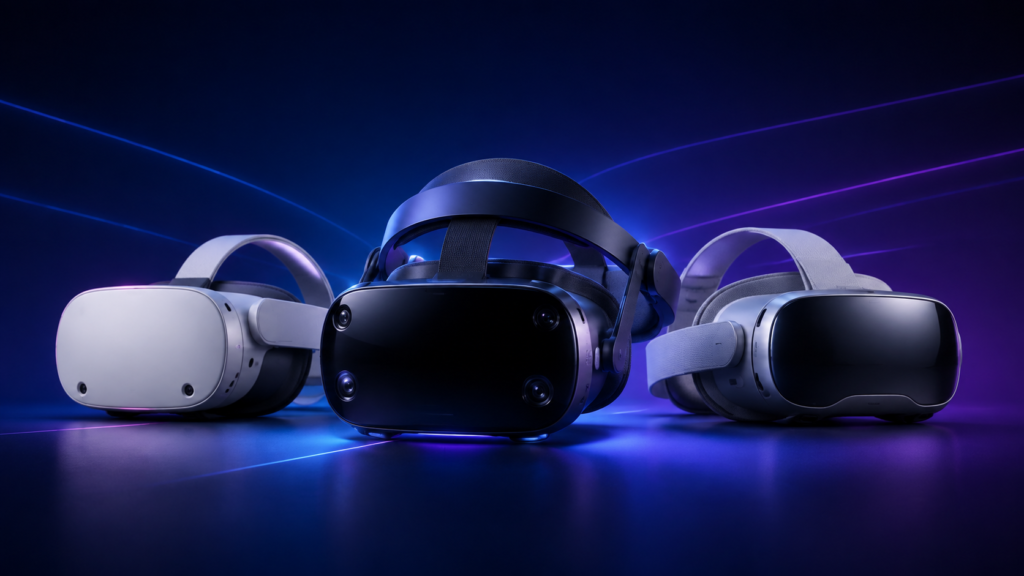
The Meta Quest 3 is the best VR headset for most people in 2026. It combines sharp pancake lenses, excellent standalone performance, convincing mixed reality and the strongest all-round software library. The cheaper Quest 3S is our value pick, while PlayStation VR2 remains a compelling choice for PS5 owners.
Quick recommendations
- Best overall: Meta Quest 3
- Best for beginners: Meta Quest 3S
- Best value: Meta Quest 3S
- Best mainstream picture quality: Meta Quest 3
- Best for PS5: PlayStation VR2
- Best premium spatial computer: Apple Vision Pro
- Best PC VR, racing and flight-simulation clarity: Pimax Crystal Light
Specifications and other price references checked 4 September 2026; Currys Quest prices rechecked 14 September 2026. Retail prices can change. This guide is based on official specifications, platform support and current UK pricing; we do not claim hands-on testing where none has taken place.
Compare headsets for your setup
Buying your first Quest? Start with our Quest 3 vs Quest 3S comparison to weigh price, lenses and storage. For the detail behind each recommendation, read the Quest 3 review or Quest 3S review.
Building a simulator? Use our VR racing setup guides and VR flight simulation guides to assess the headset alongside your PC and controls. Before buying, compare the dated retailer checks in our UK VR deals guide.
The best VR headsets at a glance
| Headset | Best for | Price reference | Key point |
|---|---|---|---|
| Meta Quest 3 512GB | Most people | £529 at Currys | Pancake lenses and 2,064 × 2,208 pixels per eye |
| Meta Quest 3S 128GB | Budget standalone VR | £319 at Currys | Quest 3 performance with simpler optics |
| PlayStation VR2 | PS5 gaming | Check current retailer price | OLED HDR, eye tracking and excellent haptics |
| Apple Vision Pro | Spatial computing | Premium pricing | M5 chip, 23 million pixels and eye/hand input |
| Pimax Crystal Light | PC simulation | From $899 before UK costs | 2,880 × 2,880 per eye and glass aspheric lenses |
Meta Quest 3S 128GB
Best for: Beginners and best value
Key advantage: Current Quest games and performance for less
Price: £319 at Currys
Meta Quest 3 512GB
Best for: Best overall and mainstream picture quality
Key advantage: Clear pancake lenses and 512GB storage
Price: £529 at Currys
Currys Quest prices rechecked 14 September 2026. Amazon prices and availability can change; use the Amazon buttons to check the latest price. Amazon buttons are affiliate links.
1. Meta Quest 3 — best VR headset overall
Quest 3 remains the easiest headset to recommend because it does almost everything well without requiring a console or gaming PC. Its Snapdragon XR2 Gen 2 processor and 8GB of memory power the same current-generation Quest library as Quest 3S, while its optical system is substantially better.
The pancake lenses give a much larger clear viewing area than the Fresnel lenses used by Quest 3S. Text is easier to read, the image remains clearer when your eyes move away from the centre, and the continuous lens-spacing adjustment makes it easier to find a comfortable setup. Resolution is 2,064 × 2,208 pixels per eye, with a 110-degree horizontal field of view.
Pros
- Sharp pancake lenses with a generous clear viewing area
- Excellent standalone game and app library
- Full-colour mixed-reality passthrough
- 512GB storage as standard
- Can also connect to a gaming PC
Cons
- Verified retailer price is £529
- Meta rates general battery life at about 2.2 hours
- The standard soft strap is functional rather than luxurious
Verdict: buy Quest 3 if you expect to use VR regularly and can afford the step up from Quest 3S. The better lenses improve nearly every minute you spend inside the headset.
2. Meta Quest 3S — best-value VR headset
The verified Quest 3S 128GB retailer price in this update is £319 and uses the same XR2 Gen 2 processor, 8GB memory, Touch Plus controllers and current Quest software platform as Quest 3. Games therefore run on the same performance class, making it a genuine current-generation headset rather than a cut-price relic.
The saving comes mainly from the display and optics. Quest 3S uses Fresnel lenses, three-position lens-spacing adjustment and 1,832 × 1,920 pixels per eye. The image is clear when correctly positioned, but the central sweet spot is smaller and the headset is bulkier. Meta rates battery life at about 2.5 hours, slightly longer than Quest 3.
Verdict: choose Quest 3S for a first headset, family use or occasional VR. Choose Quest 3 if display clarity and long sessions matter more than the £230 saving.
3. PlayStation VR2 — best for PS5 owners
PS VR2 is a wired headset built around the PlayStation 5. Its two OLED panels provide 2,000 × 2,040 pixels per eye, 90Hz or 120Hz refresh rates, HDR and an approximately 110-degree field of view. Eye tracking, headset vibration and adaptive triggers can add a level of feedback that standalone headsets rarely match.
The trade-off is flexibility. A PS5 is required for the normal console experience, the headset uses a cable and original PS VR games are not automatically compatible. A separate PC adapter opens access to SteamVR, although some PlayStation-specific features may not carry across.
Verdict: a strong choice if you already own a PS5 and want polished experiences such as Gran Turismo 7, Resident Evil 4 VR Mode and Horizon Call of the Mountain.
4. Apple Vision Pro — best premium spatial computer
Apple positions Vision Pro as a spatial computer rather than a conventional games console. The current model uses Apple’s M5 chip alongside the R1 sensor-processing chip, a 23-million-pixel micro-OLED system and eye, hand and voice input. It is particularly impressive for huge virtual displays, immersive video, productivity and integration with a Mac.
It is also heavy at 750–800g before the separate 353g battery, offers roughly 2.5 hours of general battery use and costs several times more than mainstream headsets. The VR game library is not its main strength.
Verdict: exceptional technology for enthusiasts, professionals and Apple users with a specific spatial-computing need—but not the sensible first choice for ordinary VR gaming.
5. Pimax Crystal Light — best for PC simulation enthusiasts
Pimax Crystal Light targets demanding PC VR users, particularly flight simulation and sim-racing fans. Official specifications list 2,880 × 2,880 pixels per eye, QLED panels with Mini-LED local dimming, glass aspheric lenses and a 110-degree field of view.
It requires a powerful gaming PC and is less straightforward than a standalone Quest. UK buyers should also check final pricing, shipping, tax and support arrangements rather than relying on the headline US-dollar price.
How to choose the right VR headset
Standalone, console or PC?
Standalone headsets are quickest to use. Console VR offers high-end games without PC setup. PC VR provides the widest hardware choice and access to simulation software, but costs more and requires technical confidence.
Do lenses matter?
Yes. Pancake lenses generally offer a wider clear area and a slimmer headset than Fresnel lenses. Resolution numbers alone do not tell the whole story.
How much storage do you need?
128GB is workable if you remove games after finishing them. 256GB or 512GB is more convenient for large libraries, shared households and people who dislike storage housekeeping.
Our final recommendation
Quest 3 is the best all-round choice in 2026. Quest 3S offers almost the same software experience for much less, but the Quest 3’s pancake lenses, higher resolution and wider field of view justify the extra cost for regular users.
Sources
- Meta Quest official headset comparison
- PlayStation VR2 official technical specifications
- Apple Vision Pro official technical specifications
- Pimax official product comparison
Affiliate disclosure: Amazon buttons on this page are affiliate links. As an Amazon Associate I earn from qualifying purchases. Currys links remain ordinary retailer links while its affiliate application is pending. Recommendations are chosen independently of commission.