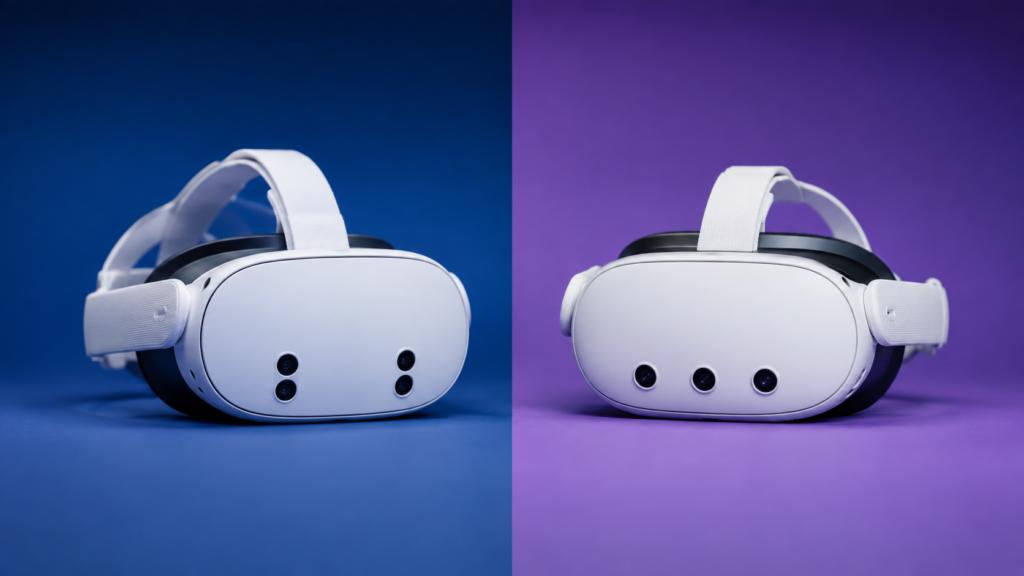
Short answer: buy Meta Quest 3 if you can comfortably afford it; buy Quest 3S if keeping the price down matters most. Both run the same current-generation Quest games, but Quest 3 has substantially better lenses, a sharper display, a wider field of view and more storage.
UK retailer prices and official specifications checked 4 September 2026.
Quest 3 vs Quest 3S: key differences
| Feature | Quest 3S | Quest 3 |
|---|---|---|
| Verified UK retailer price | £319 (128GB, Currys) | £529 (512GB, Currys) |
| Processor | Snapdragon XR2 Gen 2 | Snapdragon XR2 Gen 2 |
| Memory | 8GB | 8GB |
| Resolution per eye | 1,832 × 1,920 | 2,064 × 2,208 |
| Lenses | Fresnel | Pancake |
| Lens spacing | Three positions | Continuous adjustment |
| Horizontal field of view | 96° | 110° |
| Storage | 128GB or 256GB | 512GB |
| Rated general battery life | About 2.5 hours | About 2.2 hours |
| Passthrough | Full colour | Full colour |
Our recommendation
Choose Quest 3 for regular use, reading text, simulators, productivity and the clearest picture.
Choose Quest 3S for a first headset, occasional gaming, family use or the lowest sensible entry price.
Meta Quest 3S 128GB
Best for: Beginners and best value
Key advantage: The same current Quest games for less
Price: £319 at Currys
Meta Quest 3 512GB
Best for: Picture quality and regular VR use
Key advantage: Clearer pancake lenses and 512GB storage
Price: £529 at Currys
Currys prices checked 4 September 2026. Amazon prices and availability can change, so use the Amazon buttons to check the latest price. Amazon buttons are affiliate links; this does not affect our recommendation or the price you pay.
Performance: effectively a draw
Quest 3 and Quest 3S share the Snapdragon XR2 Gen 2 processor and 8GB of memory. They support the same current Quest software generation and Meta says both provide twice the GPU processing power of Quest 2.
That means the cheaper model is not buying you an older games platform. A title designed for Quest 3-class hardware can generally run on Quest 3S as well. Differences in perceived quality come mainly from the screen and lenses rather than a dramatic difference in processing speed.
Lenses and display: Quest 3 wins clearly
This is the most important difference. Quest 3S uses Fresnel lenses similar in principle to Quest 2. They can produce a sharp central image, but the clear sweet spot is smaller. If the headset moves slightly or your eyes look toward the edge, blur and lens artefacts become more noticeable.
Quest 3 uses pancake lenses. They create a larger edge-to-edge clear area, make text easier to read and reduce the constant urge to reposition the headset. Quest 3 also has 30% more pixels, according to Meta: 2,064 × 2,208 per eye instead of 1,832 × 1,920.
The field of view is wider too: 110 degrees horizontally on Quest 3 versus 96 degrees on Quest 3S. This gives Quest 3 a more open view of the virtual world.
Comfort and adjustment
Quest 3 is slimmer at the front and offers continuous lens-spacing adjustment. Quest 3S uses three preset positions, which may not align as precisely with every user’s eyes. Both include a soft strap, and both may benefit from an upgraded strap for long sessions.
Neither headset should be bought purely because it looks light in photographs. Face shape, strap adjustment, glasses and session length all affect comfort. If possible, try the headset or buy from a retailer with a clear returns policy.
Storage and price
The verified Currys prices in this update are £319 for Quest 3S 128GB and £529 for Quest 3 512GB. That is a £210 gap, with the Quest 3 also providing four times the storage.
Storage cannot be expanded with a memory card. Smaller games can coexist comfortably on 128GB, but large titles, recordings and a growing library require more frequent deleting and reinstalling. For a shared household, 256GB or 512GB is easier to manage.
Battery life: Quest 3S has a small advantage
Meta rates Quest 3S at about 2.5 hours of general use and Quest 3 at about 2.2 hours. Real results vary with brightness, passthrough, wireless use and the demands of each app. The difference is welcome but not large enough to choose Quest 3S for battery alone.
Mixed reality and controllers
Both headsets provide full-colour passthrough, Touch Plus controllers, hand tracking and TruTouch variable haptics. They can run mixed-reality apps that place digital objects in the room. Meta lists the same 4MP, 18-PPD passthrough fidelity for both models.
Quest 3 has a depth sensor that can make room understanding and setup more convenient, whereas Quest 3S relies more heavily on its camera-based approach. For ordinary boundary setup and basic mixed reality, both are capable.
Which should you buy?
Buy Quest 3 if:
- You expect to use VR several times a week
- Visual clarity matters to you
- You read text, use virtual screens or play detailed simulators
- You want 512GB without storage management
- You are upgrading from Quest 2 and want an obvious optical improvement
Buy Quest 3S if:
- You want the lowest-cost current Quest headset
- It is your first VR purchase
- The headset is for occasional or family use
- You care more about access to the games than maximum clarity
- The £210 saving is more useful elsewhere
Final verdict
Quest 3 is the better headset; Quest 3S is the cheaper route to almost the same games. For regular use, Quest 3’s pancake lenses are worth paying for because they improve the experience every time the headset is worn. For newcomers on a firm budget, Quest 3S delivers the important current-generation performance without the premium optics.
For more detail, read our Meta Quest 3 review or see the best headsets for every budget.
Official source
Meta Quest 3 and Quest 3S official comparison
Affiliate disclosure: Amazon buttons on this page are affiliate links. As an Amazon Associate I earn from qualifying purchases. Currys links remain ordinary retailer links while its affiliate application is pending. Recommendations are chosen independently of commission.