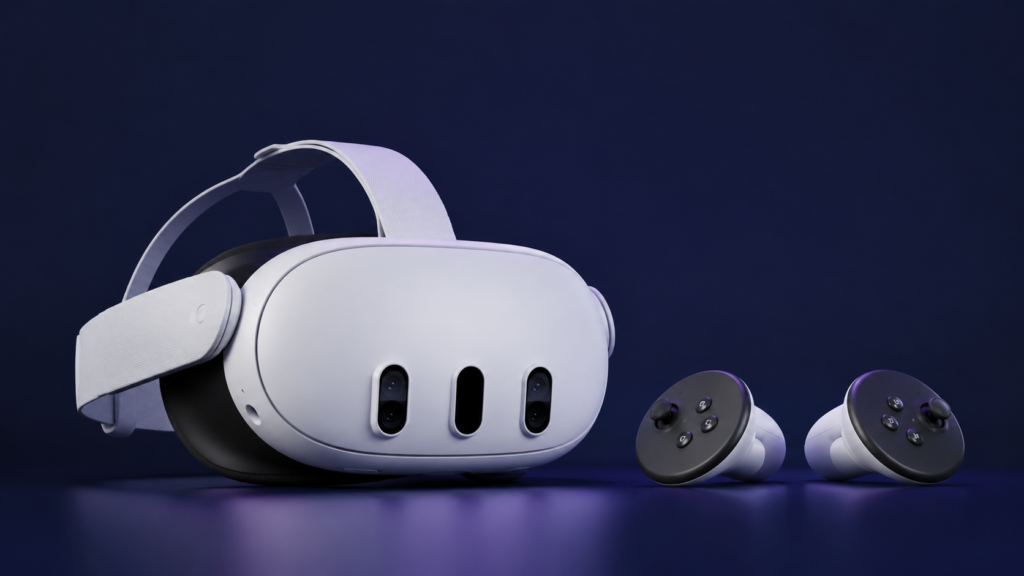
Verdict: Meta Quest 3 is still the best all-round VR headset for most buyers in 2026. Its pancake lenses, strong standalone performance and broad software library make it noticeably easier to live with than cheaper headsets.
Quest 3 scorecard
- Display and lenses: Excellent
- Performance: Very good
- Game library: Excellent
- Comfort: Good, but the standard strap is basic
- Battery: Average
- Value: Very good for regular users
UK retailer price and official specifications checked 4 September 2026. This is an editorial review based on official technical information, platform support and comparative analysis. We will label any future hands-on testing separately.
Meta Quest 3 specifications
| Verified UK retailer price | £529 at Currys |
|---|---|
| Storage | 512GB |
| Processor | Snapdragon XR2 Gen 2 |
| Memory | 8GB |
| Resolution | 2,064 × 2,208 pixels per eye |
| Lenses | Pancake, continuous lens-spacing adjustment |
| Refresh rates | 72Hz, 90Hz and 120Hz |
| Field of view | 110° horizontal, 96° vertical |
| Mixed reality | Full-colour passthrough |
| Rated general battery life | About 2.2 hours |
What makes Quest 3 special?
Quest 3 sits in a useful middle ground. It works by itself, so there is no need for a console, PC or external tracking equipment. It can also connect to a gaming PC for compatible PC VR titles. That makes it suitable for newcomers without giving experienced users nowhere to go.
The biggest everyday advantage over Quest 3S is not raw processing power—the two headsets share the same XR2 Gen 2 platform—but the optical system. Quest 3 uses pancake lenses and two higher-resolution displays. The result is a larger clear area, easier reading and less need to keep the headset positioned with millimetre precision.
Display and lens quality
Meta lists 2,064 × 2,208 pixels per eye, 1,218 pixels per inch and 25 pixels per degree. Those numbers matter, but the pancake lenses make the more obvious difference. Fresnel lenses often look sharp mainly in the centre; pancake optics allow your eyes to move around the view with less immediate blur.
The continuous lens-spacing control also accommodates a wider range of users than a three-position system. People who share a headset should find it quicker to adjust. The 110-degree horizontal field of view is wider than Quest 3S and helps the virtual world feel less like it is being viewed through binoculars.
Performance and games
The Snapdragon XR2 Gen 2 and 8GB of memory place Quest 3 in Meta’s current software generation. It supports newer Quest titles and receives the same core game compatibility as Quest 3S. The library covers rhythm games, fitness, action, simulation, social apps, entertainment and creative tools.
For higher-end PC VR, Quest 3 can connect wirelessly or by a compatible USB cable. Results depend on the gaming PC, network and connection method, but this extra route extends the usefulness of the headset beyond its standalone store.
Mixed reality and passthrough
Full-colour passthrough lets the headset show your real room while digital objects are placed within it. It is useful for setting boundaries, finding controllers and running mixed-reality games. The view is functional rather than indistinguishable from normal sight: lighting, small text and fine detail can expose its camera-based nature.
Even so, mixed reality makes Quest 3 feel more flexible than a headset designed only to block out the room. Applications can use furniture, walls and floor space as part of the experience.
Comfort and design
Meta says Quest 3 is 30% slimmer than Quest 2 when the facial interface is excluded. The flatter front helps, but weight still sits on the face and the supplied soft strap prioritises low cost and packability over perfect balance.
Many regular users eventually consider a rigid or battery head strap. That can improve stability and counterbalance, but it raises the real ownership cost. Glasses wearers should check fit carefully and consider compatible prescription inserts for the cleanest setup.
Battery life
Meta rates general use at roughly 2.2 hours. Demanding games, brightness, wireless conditions and passthrough use can affect that figure. It is enough for a typical session, but not a strength. A battery strap or power bank can extend play, provided it is designed and positioned safely.
Quest 3 pros and cons
Pros
- Excellent pancake lenses
- Strong standalone performance
- Large current-generation library
- Useful mixed-reality capability
- 512GB storage
- Optional PC VR connection
Cons
- £529 is a substantial purchase
- About 2.2 hours rated battery life
- Standard strap may not suit long sessions
- Accessories increase the final cost
Who should buy Meta Quest 3?
Quest 3 is the right choice for someone who expects to use VR regularly, cares about visual clarity and wants one headset for games, fitness, media, mixed reality and occasional PC VR. It is particularly easy to recommend to people upgrading from Quest 2.
Buy Quest 3S instead if price is the deciding factor, the headset will be used occasionally or it is mainly for children and family entertainment. The games run on the same processor class, although the view is less refined.
Meta Quest 3 512GB
Best for: Best overall and best picture quality for mainstream standalone VR
Key advantage: Clear pancake lenses, strong mixed reality and 512GB storage
Price: £529 at Currys
Currys price checked 4 September 2026. Amazon prices and availability can change; use the Amazon button to check the latest price. The Amazon button is an affiliate link.
Final verdict
Meta Quest 3 earns our best-overall recommendation. It is not perfect, and the battery and standard strap leave room for improvement. But the clarity of its pancake lenses and the convenience of standalone VR make it the most balanced mainstream headset available in the UK in 2026.
Official source
Meta Quest headset comparison and specifications
Affiliate disclosure: Amazon buttons on this page are affiliate links. As an Amazon Associate I earn from qualifying purchases. Currys links remain ordinary retailer links while its affiliate application is pending. Recommendations are chosen independently of commission.