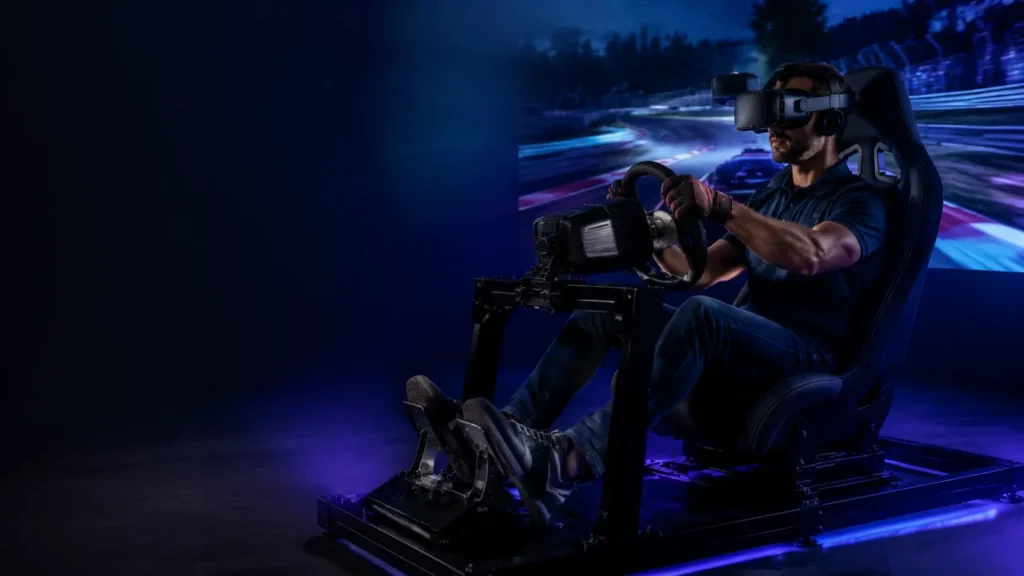
Updated September 2026. VR can transform sim racing because you judge corners, braking distances and the position of nearby cars in three dimensions. The difficult part is choosing a headset that suits both your PC and your budget.
For most racers, the Meta Quest 3 is the sensible starting point. It is easy to buy in the UK, has clear pancake lenses and works both wirelessly and through a Link cable. Racers who want a dedicated PCVR headset should look at the Pimax Crystal Light. At the premium end, the Pimax Crystal Super prioritises resolution and a wide field of view, while the remarkably light Bigscreen Beyond 2 is designed for comfort during long sessions.
This guide explains the genuine differences, the extra equipment each headset needs and where your money is best spent.
Best VR headsets for sim racing: quick answer
| Headset | Best for | Main strength | Important drawback |
|---|---|---|---|
| Meta Quest 3 | Most sim racers | Excellent lenses, simple setup and strong value | PC image is streamed rather than sent by native DisplayPort |
| Pimax Crystal Light | Dedicated PCVR value | Very sharp 2880 × 2880-per-eye image | Heavier and more demanding than Quest 3 |
| Pimax Crystal Super | Maximum cockpit detail | Extremely high resolution and wide field of view | Needs a powerful PC and a substantial budget |
| Bigscreen Beyond 2 | Long endurance sessions | Only 107g with dual micro-OLED displays | SteamVR base stations and controllers are separate |
Our recommendation in one sentence
Buy the Quest 3 if you are starting out, the Crystal Light if you want a sharper dedicated PCVR upgrade, the Crystal Super if visual detail matters more than cost, or the Beyond 2 if headset weight is your biggest concern.
1. Meta Quest 3 — best VR headset for most sim racers
The Quest 3 is our best all-round recommendation because it makes good VR accessible without immediately turning the purchase into a major engineering project. Its pancake lenses provide a broad, clear viewing area, so you can glance towards mirrors and instruments without constantly moving your whole head.
Meta lists a resolution of 2064 × 2208 pixels per eye and a headset weight of 515g. PC support is available through a compatible Quest Link cable or a suitable wireless connection. Inside-out tracking means you do not need to install external base stations around the room.
Why it works well for racing
- Clear pancake optics make dashboards and braking markers easier to read.
- Inside-out tracking keeps the installation simple around a fixed cockpit.
- It can be used for standalone VR as well as PC sim racing.
- Wired and wireless PC options let you choose between convenience and consistency.
- It has a large accessory market for improved straps, facial interfaces and longer cables.
What to know before buying
Quest PCVR uses compressed video rather than a direct DisplayPort connection. A good cable or fast, well-configured network can look excellent, but dedicated PCVR headsets can deliver a cleaner image. The standard soft strap is also not our first choice for long races, so allow for a better head strap in your budget.
Verdict: the best first purchase for most people and the safest recommendation when you also want general VR gaming.
Check the official Meta Quest 3 specifications
2. Pimax Crystal Light — best dedicated PCVR value
The Crystal Light is aimed squarely at PC users who care more about cockpit clarity than standalone apps. Pimax specifies 2880 × 2880 pixels per eye, glass aspheric lenses, up to 120Hz refresh and an approximately 110-degree field of view.
That extra resolution is useful in sim racing. Small dashboard text, distant braking boards and cars further along the circuit can appear more defined than they do through a lower-resolution headset.
Why it works well for racing
- High per-eye resolution for instruments and distant track detail.
- A direct PCVR design avoids the video compression associated with standalone headsets.
- Inside-out tracking can be used without SteamVR base stations.
- Local dimming is available on supported versions for improved contrast.
What to know before buying
The sharper display asks much more from your graphics card. You may need to reduce resolution, shadows, reflections or the number of visible cars to maintain a smooth frame rate. It is also physically larger than the Quest 3 and Beyond 2, so fit and balance deserve attention.
Verdict: a strong step up for racers who already own a capable gaming PC and mainly want a headset for seated simulation.
Check the official Pimax Crystal Light specifications
3. Pimax Crystal Super — best for maximum clarity and field of view
The Crystal Super is the no-small-measures option. Pimax lists the Ultrawide version at 3840 × 3840 pixels per eye with a claimed 140-degree horizontal field of view. A wider view can make a racing cockpit feel less like looking through goggles and gives better awareness of cars alongside you.
The resolution also targets the details that matter in simulation: instrument panels, distant apexes, kerbs and trackside signs. It is the headset here most likely to expose the limits of your PC.
Why it works well for racing
- Exceptional resolution for detailed cockpits and distant scenery.
- Wide field of view improves peripheral awareness.
- Designed and marketed specifically for demanding PC simulation.
- Suitable for a premium cockpit where image quality is the priority.
What to know before buying
A headline display resolution does not mean every racing game should be run at its maximum setting. Even a top-end graphics card may require sensible adjustments or upscaling. The headset is also a premium purchase, so the total system cost should include the PC, wheelbase, pedals and cockpit rather than treating the headset in isolation.
Verdict: the enthusiast choice for maximum presence and detail, provided your PC and budget are equally enthusiastic.
See Pimax’s official sim-racing headset information
4. Bigscreen Beyond 2 — best for comfort and endurance racing
Comfort becomes increasingly important once a race lasts an hour rather than ten minutes. Bigscreen lists the Beyond 2 at just 107g, with dual micro-OLED displays, 2560 × 2560 pixels per eye, pancake optics and a claimed 116-degree diagonal field of view.
The tiny form factor reduces the leverage and heat associated with a large headset. For endurance races, league nights and long practice sessions, that can matter as much as another line on a specification sheet.
Why it works well for racing
- Extremely low headset weight.
- Micro-OLED panels provide deep blacks and strong contrast.
- Native SteamVR tracking is accurate and established.
- A wired connection suits permanent racing cockpits.
What to know before buying
The price of the headset is not the complete system price. You need compatible SteamVR base stations, and controllers are required if you want to use it beyond seated racing. Bigscreen’s fitting system is more personal than a typical shared headset, which is excellent for the owner but less convenient for a household with several users.
Verdict: the comfort specialist for racers who already have—or are happy to build—a SteamVR setup.
Check the official Bigscreen Beyond 2 specifications
What matters most in a sim-racing headset?
Lens clarity
A wide clear area is more useful than a sharp image only in the centre. Pancake and good aspheric optics allow your eyes to scan mirrors and instruments more naturally.
Resolution
Higher resolution improves dashboard text and distant detail, but it increases the graphics workload. The best headset is not helpful if your PC can only run it with an inconsistent frame rate.
Field of view
A wider field of view improves peripheral awareness and immersion. Manufacturer measurements are not always directly comparable, so treat field-of-view figures as guidance rather than building-control drawings.
Comfort and weight
Sim racers sit still for long periods, making pressure on the forehead, cheeks and neck particularly noticeable. Strap design, facial interface shape and cable management all affect comfort.
Connection type
A native DisplayPort connection generally provides a clean, consistent PC image. Quest headsets instead receive a compressed video stream over USB or Wi-Fi, trading a little purity for flexibility and simplicity.
Tracking
Seated racing does not normally require elaborate room-scale tracking. Inside-out tracking is sufficient for most cockpits. SteamVR base stations remain relevant for headsets such as the Beyond 2 and for owners who already use tracked controllers.
How powerful does your PC need to be?
VR effectively asks the PC to render a high-resolution view for each eye while maintaining a steady frame rate. Simulators also place significant demand on the processor, particularly with large grids, weather and detailed physics.
- Entry level: start with Quest 3 at moderate resolution and settings.
- Upper mid-range: suitable for Quest 3 at higher settings or Crystal Light with careful tuning.
- High end: recommended for Crystal Light at ambitious settings, Beyond 2 supersampling or Crystal Super.
Do not judge performance from the graphics card alone. CPU speed, memory, cooling, USB reliability and the individual simulator all matter. Smooth delivery is more valuable than a beautiful screenshot followed by a corner taken at twelve frames per second.
Wired or wireless for sim racing?
Wireless freedom is wonderful for room-scale VR, but it is less important when you are strapped into a fixed seat holding a wheel. A wired connection avoids battery concerns and reduces dependence on network quality. Route the cable above or behind the cockpit so it cannot catch the wheel, shifter or seat runners.
Quest 3 owners can still choose wireless PCVR when the router and room layout are suitable. For organised league racing, many users will prefer the predictability of a cable.
Which headset should you buy?
- New to VR or unsure: Meta Quest 3.
- Dedicated PC racer wanting sharper visuals: Pimax Crystal Light.
- Premium cockpit and powerful PC: Pimax Crystal Super.
- Long sessions and minimum weight: Bigscreen Beyond 2.
Before ordering, check prescription-lens options if you wear glasses, measure your available USB and DisplayPort connections, and confirm that your chosen simulator supports the headset’s runtime. Prices, bundles and availability change regularly, particularly for specialist imported hardware.
Final verdict
The Meta Quest 3 is the best VR headset for most sim racers in 2026 because it combines good optical clarity, simple tracking and reasonable total cost. The Pimax Crystal Light is the logical dedicated-PC upgrade, while the Crystal Super is for racers chasing maximum detail and peripheral vision. Choose the Bigscreen Beyond 2 when comfort over long sessions is the deciding factor.
Whichever headset you choose, reserve some budget for comfort accessories and PC performance. In sim racing, a stable frame rate and a headset you can wear for two hours will improve the experience more than chasing the largest number on the box.
Explore more VR racing setup guides or visit our VR flight simulation section.
Editorial note: Specifications were checked against manufacturer information in September 2026. Prices and availability can change. This guide contains no paid placement; any future affiliate links will be clearly disclosed and will not affect our recommendations.
Pingback: Best VR Headsets for Flight Simulation 2026 | UK Guide